What is IOS Initiative?
IOS – In-orbit servicing initiative creates a framework to enable clients and service vendors to manage delivery of services through an interoperable framework.
This initiative extends the existing In-Orbit Refueling (IOR) Systems Engineering framework in two dimensions:
- Extended Service Scope: Extend the IOR ecosystem to support additional In-Orbit Servicing (IOS) capabilities beyond refuelling.
- Autonomous Service Delivery: Enable clients and service providers to autonomously discover, coordinate, and utilize interoperable in-orbit services within a unified IOS ecosystem.
The initiative builds upon the existing IOR Systems-of-Systems architecture, interfaces, and engineering framework, with the objective of enabling a scalable and interoperable ecosystem for autonomous in-orbit services.
The initial focus is on autonomous in-orbit refuelling, with the framework designed to be extensible to other in-orbit servicing capabilities.
What is Auto-IOS?
Auto-IOS delivers a globally available infrastructure through which autonomous constellations can discover service providers and obtain required services without human intervention.
The Autonomous-In-Orbit Services System enables clients to discover these service providers and engage them to receive services.
Auto-IOS consists of three key components:
- Auto-IOS Cloud – A continuously available, cloud-based service broker that connects ecosystem participants. Service providers register their services with Auto-IOS Cloud, and clients use it to discover available service providers and the services they offer.
- Systems-of-Systems (SoS) Engineering Framework and Interfaces – The SoS Engineering Framework defines the system-level requirements, Concepts of Operations (CONOPS), system architecture, and interface requirements and specifications. It establishes the common framework that enables independently developed systems from different vendors to work together. Interface Requirements Documents (IRDs) and Interface Control Documents (ICDs) define the requirements and specifications for each interface.
Once a client and service provider engages, their systems communicate through these well-defined interfaces.
- Auto-IOS Seed Auto-IOS Seed is software embedded in participating system components, including spacecraft, orbital transfer vehicles (OTVs), service provider systems, and ground segments. System-specific Auto-IOS Seed components implement the interfaces defined by the SoS Engineering Framework, enabling participating systems to communicate and interact within the Auto-IOS ecosystem. The software will be developed in suitable high-level programming languages and made available to system developers for integration into their systems.
Through these three components, independent organizations can participate in the IOS ecosystem by developing and deploying interoperable components and services without having to build proprietary, end-to-end solutions.
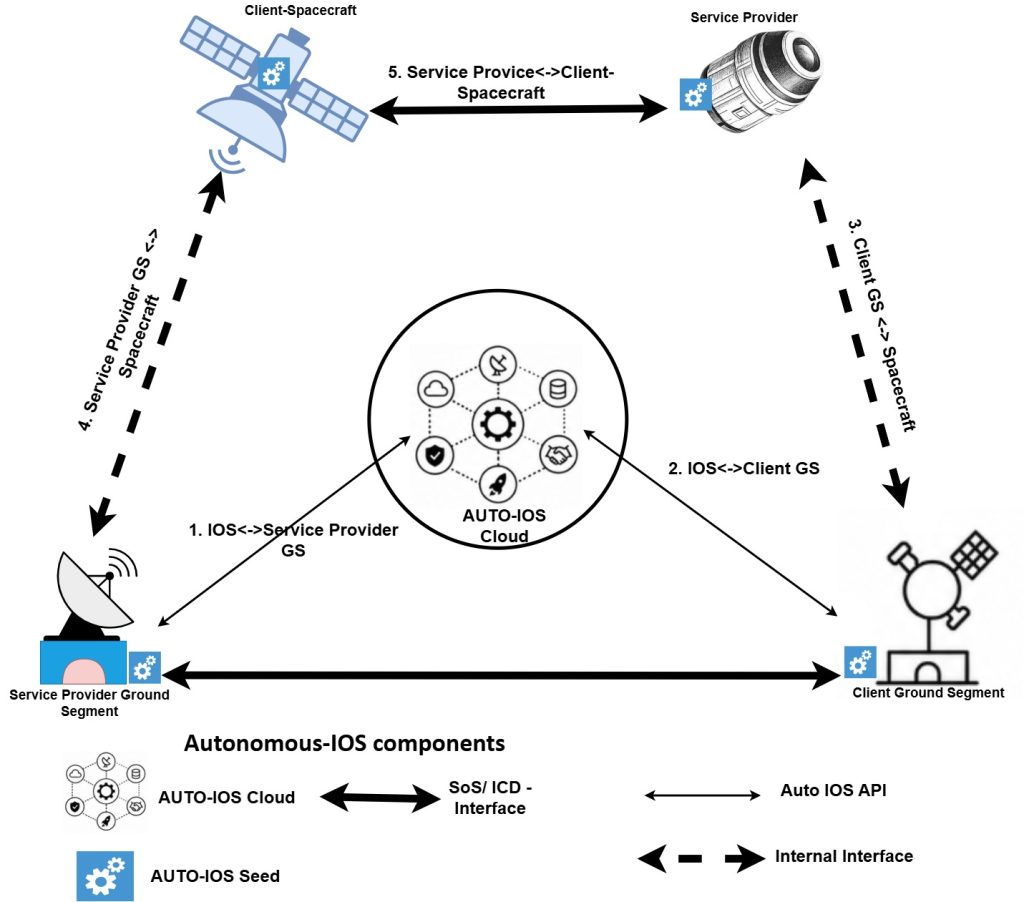
Autonomous-IOS components:
- SoS Engineering Artifacts
- Auto-IOS Cloud – Broker
- Auto-IOS Seed
Why Auto-IOS is required?
As autonomous constellations proliferate, autonomous identification, discovery, and fulfillment of service needs without human intervention will become essential.
Enabling multiple service vendors and clients to participate in a common system requires a Systems-of-Systems engineering framework defining unified requirements, Concepts of Operations (CONOPS), architecture, and interfaces.
Today’s In-Orbit Services (IOS) are largely being developed as vertically integrated, proprietary solutions in which a single provider develops and delivers the complete value chain. However, no single vendor can provide every type of IOS service within one framework.
A unified, global system is therefore required, enabling independent vendors to participate in requesting and providing services through common standards and open interfaces.